Pages

Tuesday, April 6, 2010

Yellow Star


Roy, J. (2006). Yellow star. Tarrytown, NY: Marshall Cavendish.

Genre: Biography
Format: Chapter Book
Recommended Age: 10-12
Awards: 2009 William Allen White Award

A relative of the main character, Roy tells the true story of Syvia, a young Jewish survivor of WWII who spent the majority of the war locked in the Lodz Ghetto among thousands of other Jews. From the time Syvia was 4 1/2 years-old to when she was released at the age of 10, Syvia witnessed unspeakable horrors during her time in the ghetto. Told from the perspective of a child, at times the dreadful events were vague, yet at the same time perfectly obvious to the adult reader, such as the sudden disappearance of her friend Hava. Throughout her time there, children were murdered, families were shipped off on trains to meet their eventual death, and the Jewish extermination was well underway, yet miraculously, Syvia and her family survived, with Syvia being one of only 12 children left alive in the ghetto. The content of the book is violent at times, sad at others, yet sprinkled with happier memories here and there. Although the prose is never too violent, I would still recommend this book for children ages ten and up, as they are so easily drawn to stories of adversity and individuality. The fact that the story told here is true will only serve to grasp their attention even more. Beautifully told, this story will capture the hearts of readers. They will both laugh and cry, and be inspired to press on in the face of difficulties as Syvia and her family did when it seemed all hope was lost.

Ford, S. (2006, October 19). Yellow Star - Jennifer Roy [Review of the book Yellow Star]. Message posted to http://childlitbookclub.blogspot.com/2006/10/yellow-star-jennifer-roy.html.

On her blog for The Children's Literature Book Club, Stephanie Ford provides a wealth of insight into Roy's work Yellow Star. In addition to an overview of the book, Ford points out that "Holocaust books for middle grades can be very difficult because they shouldn’t hide the truth, but they shouldn’t be overly graphic and gruesome. Yellow Star walks the fine line perfectly because it’s told from the point of view of a young girl who didn’t always understand the truth and her parents and older sister protected her as much as they could." Ford also mentions that the story seems to be strengthened through verse, as "the simplicity of prose matches the descriptions young Syvia lends credit to her perspective as a child." Ford gives far more valuable insight than I tend to see in other book reviews, perhaps because of its blog format, so I particularly enjoyed reading her review of the book. She had nothing but positive things to say, and the same goes for me.

Monday, April 5, 2010

Scaredy Squirrel


Watt, M. (2006). Scaredy Squirrel. Tonawand, NY: Kids Can Press.

Genre: Easy to Read
Format: Picture Book
Recommended Age: 4-6

Words can not fully express how much of a delight Scaredy Squirrel is to virtually any reader. Scaredy is an agoraphobic squirrel, too frightened to venture out of his tree in case of an unexpected mishap with the likes of tarantalas, poison ivy, killer bees, green martians, germs, and sharks. Through the use of humor, colorful illustrations, and many lists, Watt reveals Scaredy's daily schedule, the advantages and disadvantages of leaving his nut tree, and his own well-thought out emergency exit plan. Yet things don't go quite according to plan when Scaredy suddenly spots a "killer" bee and in a frenzy drops his emergency kit. Without thinking, Scaredy leaps out of the tree to retrieve it only to accidentally discover that he's not just any squirrel, but a flying squirrel. After hours of playing dead upon his landing, Scaredy finds that nothing horrible happens if he leaves his tree after all, and in the end he incorporates both flying and playing dead into his new daily routine. Joyful, witty, and filled with adorable illustrations, Scaredy Squirrel is a treasure. Children of all ages will enjoy this book, and adults will enjoy reading it to them. Children ages 4-6 will especially enjoy the artwork and the many lists used to tell the story. It is of my opinion that every home, school, and library should own not just this book, but the whole series.

Payne, R.G. (2006, June 1). Reviews: Preschool to Grade 4 [a book review of Scaredy Squirrel]. School Library Journal. Retrieved April 3, 2010 from http://www.schoollibraryjournal.com/article/CA6340931.html.

Having not even read Payne's review before writing my own, I found both our reviews and our opinions to be strangely similar. Payne gives a quick, witty summary of the book, and ends by saying, "with his iconic nervous grin and over-the-top punctiliousness, Scaredy Squirrel is an endearing character. Thick-lined cartoons with bold patches of color, quirky charts and graphs, and clever asides provide humor that will appeal to children...Scaredy Squirrel needn't fret about finding readers to cheer him on." Short, sweet, and to the point, this review is for those who want just the basic overview of the book, yet Payne still delivers a positive review by keeping the fun and witty tone of the book throughout her review.

Electricity: Bulbs, Batteries, & Sparks


Stille, D.R. (2004). Electricity: Bulbs, batteries, and sparks (Sheree Boyd, illus.). Minneapolis, MN: Picture Window Books.

Genre: Non-fiction/Informational
Format: Picture Book
Recommended Age: 7-9

Stille's book Electricity: Bulbs, Batteries, & Sparks is a treasure trove of information. Children will learn about where electricity comes from, how it's made, how we store it, and the many uses we have for it in this world. Simple, colorful illustrations accompany each new page, demonstrating acts such as a girl using electricity to blow-dry her hair or a boy using electricity to turn the TV on and off. Pictures of powerlines and windmill farms also give children a visual image of the many ways we create and store electricity. Scattered throughout the book are "fun facts" and at the back of the book children are provided with fun science experiments to try out, as well as important safety tips concerning electricity. This book would work wonders for children ages 7-9, as it is a wonderful introduction to children on the topic of electricity. Children will get fun illustrations they wouldn't usually get with textbooks, and the experiments in the back will give them hands-on experience they need to better understand electricity and how it works. An excellent resource for the classroom and any library, I highly recommend this work to any collection.

Sunday, April 4, 2010

OK Go by Carin Berger


Berger, C. (2009). Ok Go. New York: Greenwillow Books.

Genre: (Nearly) Wordless
Format: Picture Book
Recommended Age: 2-4

Carin Berger uses OK Go as an environmental plea to children to take care of their planet. Charming collages made of recycled materials such as old patterned papers, magazines, letters, & newspapers create a setting of a seemingly neverending traffic jam, where the only accompanying words are "Go." Soon after, though, smog fills the air, and the characters are pleaded with a two-page spread yelling "Stop!" A few pages later, children are given a solution with a whimsically illustrated fold-out spread filled with flowers, balloons, sunshine, and a plethora of happy things, accompanied by the chracters finding new ways to get to where they're going. "Waste less, Jess," it says. "Roller skate, Kate," it suggests. "Use the bus, Gus. Recycle, Michael," it pleads. At the end, the characters are assured that all is well conce again as one yells happily, "OK Go!"

Being a nearly wordless book, I would suggest this book for children aged 2-4 years. Children will love the bright, unique illustrations, and will undoubtedly love reciting the simple words back as it's read to them. Some parent could possibly have an issue with the strong environmentalist message of the book, yet the message is not too overpowering. After all, it's never too early to teach children to be resourceful and to be a good steward of their belongings and this beautiful planet on which we reside. I would recommend this book for home, school, and public libraries, as it serves as an excellent introduction to teaching children good stewardship.

Elleman, B. (2009, April 1). Reviews: Preschool to Grade 4. [a book review of OK Go]. School Library Journal. Retrieved April 4, 2010 from http://www.schoollibraryjournal.com/article/CA6648615.html?q=OK+Go.

Never have I read a more eloquent review of a book with so little words in it itself. Elleman perfectly captures the essence of OK Go through her description of the plot, using phrases such as, "Idiosyncratic creatures decked out in fabric pieces, buttons, and tall imaginative hats sail along in even more idiosyncratic vehicles that are variously colored and decorated with stickers and decals." Elleman gives the book an overall positive review, saying "While the opening pages may puzzle younger children, the offbeat presentation will undoubtedly initiate interest among older readers, and the fanciful collages (made from recycled materials) will have artistic readers poring over the pages." I couldn't agree more with Elleman's review, as I personally found the message to be positive yet not overwhelming, and was utterly captivated by the fanciful illustrations. A good review of a good book in my opinion.

Django: World's Greatest Jazz Guitarist


Christensen, B. (2009). Django: World's greatest jazz guitarist. New York: Roaring Brook.

Genre: Biography/ Poetry
Format: Picture Book
Awards: 2009 Schneider Family Book Award
Recommended Age: 8-10

Django: World's Greatest Jazz Guitarist by Bonnie Christensen is truly a work of art. Having myself never even heard of Django, Christensen's work served both as a history lesson and as a lesson in will and determination. As the book relates, Django grew up as a traveling gypsy in France. A hard life through and through, Django pressed on and began writing and playing music at an early age. The text describes this beautifully through the use of poetry when it says "Still a boy he's playing dance halls. Fingers flying down the fretboard. Writing waltzes, making records, putting money on the table. Known around the streets of Paris 'Gypsy Genius,' 'Prodigy Boy'." Django became well-known throughout Europe, yet tragedy soon struck when a fire severely impaired him: "'Such awful burns, that leg, that hand.' The hand he used to fret guitar---Burned so deeply, nearly useless." Against all odds, however, through hard work and determination, Django was one day able to take the stage again and play his music for all to hear. Captured beautifully through oil paintings and rhythmic poetry, Christensen presents an inspirational story that both children and adults will appreciate.

Django would be an ideal book for children ages 8-10, as the poetry can at times be a little more difficult for younger children to understand. In addition, the content teaches a more serious topic, showing children how hard life can be, but also revealing to them that obstacles can indeed be overcome. Children will certainly enjoy the illustrations within as well as the poetic style that so brilliantly accompanies them. I highly recommend this as a book to add to any and all library collections.

Goedhart, B. (2010, March 13). True stories, real people: Henry Aaron, Django Reinhardt, Houdini, and Tim Horton are among the subjects of new illustrated biographies for children. The Gazette (Montreal). Retrieved April 2, 2010 from LexisNexis Academic database.

Perhaps what I appreciated most about Goedhart's review was his inclusion of other biographies in addition to his review of Django: World's Greatest Jazz Guitarist. Goehart did not shy away from praising Chrsitensen's work, as he deemed that the "text has a music all its own, written in a free-verse style and accompanied by lively, vibrantly coloured paintings that befit the gypsy arts and lifestyle." In addition, Goedhart made a very practical suggestion that I hadn't thought of, which was to provide a CD of Django's work to accompany the book. This would surely give the book even more meaning to its readers, as children would be able to hear the music for themselves. Among other books that Goedhard reviewed for this article were Henry Aaron's Dream by Matt Tavares, Shake, Rattle, & Turn that Noise Down: How Elvis Shook up Music, Me, & Mom by Mark Alan Stamaty, and It's a Snap! George Eastman's First Photograph by Monica Kulling, illustrated by Bill Slavin, yet many more are included within the article. I would highly recommend one give this review a read if they are looking for a good biography to introduce their child to.

Thursday, April 1, 2010

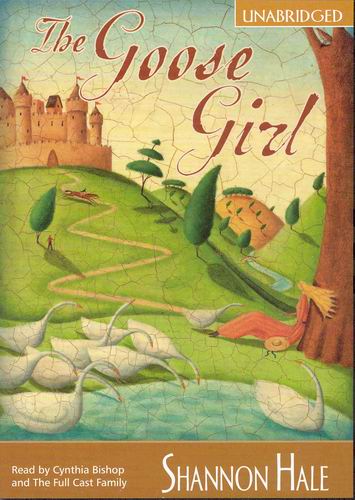
Goose Girl


Hale, S. (2003). The goose girl. Syracuse, NY: Full Cast Audio.

Genre: Folk Tale
Format: Audio Book
Recommended Age: 8 & Up

It's been several months since I listened to this audio book, but I loved it so much that I simply have to review it. In Shannon Hale's Goose Girl, 16 year-old Anidori-Kiladra Talianna Isilee, Crown Princess of Kildenree, is promised in marriage to the neighboring Prince of Bayern and shipped to Bayern to meet the royal family. However, trouble arises when the Princess's guards and lady-in-waiting betray her, carrying out a scheme to murder her and allow Selia to take on her identity. The princess barely escapes with her life, and spends the remainder of the story disguised as Isi, the goose girl on the Prince's very estate, who ,unbeknownst to everyone, can magically speak to animals as well as the wind. Wrapped in adventure, romance, and imagination, The Goose Girl is a must-read and an even greater listen, as the audio book provides listeners with a full cast of characters.

Were this merely just the printed book, I would recommend an age of at least 10 and up, but because it's an audio book, I think children from even age eight, and maybe younger, can both understand and enjoy the content since it is more of a storytelling or a play than a book. If parents, teachers, or librarians have a desire to introduce children to the world of audiobooks, Goose Girl will be the perfect starting point, and kids will undoubtedly get hooked because of it.

Lombardo, C. (2006, February 1). Goose Girl [A review of the book Goose Girl]. School Library Journal. Retrieved April 1, 2010 from LexisNexis Academic database.

Short and sweet, this review speaks the highest praise of Shannon Hale's retelling of the classic fairy tale, Goose Girl. Providing details of the adventurous plot, as well as the audio cast, which apparently consisted of more than four dozen actors, Lombardo clearly loves both the story and the format it's presented in. I couldn't agree with her opinion any more.

Jumping to Conclusions


Brunstetter, W.E. (2009). Jumping to conclusions. Rachel Yoder, Always Trouble Somewhere Series, Book #7. Uhrichsville, OH: Barbour Pub.

Genre: Contemporary Realistic Fiction/ Religious Fiction
Format: Chapter Book
Recommended Age: 8-12

Jumping to Conclusions is the 7th book in Brunstetter's charming "Rachel Yoder-Always Trouble Somewhere Series", yet don't let the fact that it's the 7th dissuade you from reading it. Having read none of the previous books in the series, I still found this book to be an absolute delight! Set in an Amish community, eleven year-old Rachel Yoder constantly finds herself getting into trouble. Within the pages of this particular book, Rachel gets into several predicaments after having eavesdropped on other's conversations and "jumped to conclusions." Although it takes several incidents of the same mistake, Rachel ends up learning many valuable lessons throughout the book, and despite her constant troubles, she is continually surrounded by a warm and loving family who aren't afraid to speak the truth in love.

This book is perfect for children ages 8-12, especially since children within this age group are typically drawn to series of books. Readers will laugh at Rachel's predicaments, learn about a different culture, learn bits and pieces of Pennsylvania Dutch, and find that they can even relate to an eleven year-old Amish girl. Just like most children, Rachel gets into arguments with her siblings, is prone to clumsiness, and at times says and does things that she knows are wrong. This book is a great starting point for discussion about areas such as family dynamics, eavesdropping, and gossip, yet given it's Christian background some parents might find it offensive as it includes Bible verses and lessons. Nonetheless, though, I deem it a wonderful addition to any library!

Tidman, M. (2010, January 1). Jumping to conclusions [A review of the book Jumping to Conclusions: Rachel Yoder-Always Trouble Somewhere Series, Book 7]. School Library Journal. Retrieved April 1, 2010 from LexisNexis Academic database.

Much to my surprise, Tidman's review of Jumping to Conclusions took on a flat tone and came across as thoroughly unimpressed. She did a wonderful job of recapping the story's main events, yet it seems as though that was all she did. If I were to read this review, I probably would not have wanted to read the book, despite the fact that she didn't necessarily give it a negative review. I of course agree that although "Rachel's adventures are set in a modern Amish settlement, young listeners will easily identify with her moods and mishaps", and I also agree to an extent that the events were somewhat repetitive, yet at the same time the repeated mistakes of Rachel are more true to life than most of us would like to admit. I also don't necessarily agree with Tidman's suggestion to purchase the book only wherever previous books are available, as it often refers to events in earlier books. While earlier events are mentioned, I personally did not ever feel like this detracted from the current plot, nor did I find myself confused about the mentioned past events. This book is by no means going to be an award winner, but I find the cultural Amish roots and moral values instilled in this book to be intriguing and thought-provoking, and would have no hesitation in reading it to my own children someday.