Pages

Thursday, April 1, 2010

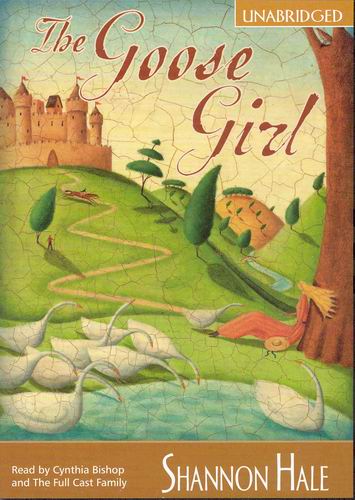
Goose Girl


Hale, S. (2003). The goose girl. Syracuse, NY: Full Cast Audio.

Genre: Folk Tale
Format: Audio Book
Recommended Age: 8 & Up

It's been several months since I listened to this audio book, but I loved it so much that I simply have to review it. In Shannon Hale's Goose Girl, 16 year-old Anidori-Kiladra Talianna Isilee, Crown Princess of Kildenree, is promised in marriage to the neighboring Prince of Bayern and shipped to Bayern to meet the royal family. However, trouble arises when the Princess's guards and lady-in-waiting betray her, carrying out a scheme to murder her and allow Selia to take on her identity. The princess barely escapes with her life, and spends the remainder of the story disguised as Isi, the goose girl on the Prince's very estate, who ,unbeknownst to everyone, can magically speak to animals as well as the wind. Wrapped in adventure, romance, and imagination, The Goose Girl is a must-read and an even greater listen, as the audio book provides listeners with a full cast of characters.

Were this merely just the printed book, I would recommend an age of at least 10 and up, but because it's an audio book, I think children from even age eight, and maybe younger, can both understand and enjoy the content since it is more of a storytelling or a play than a book. If parents, teachers, or librarians have a desire to introduce children to the world of audiobooks, Goose Girl will be the perfect starting point, and kids will undoubtedly get hooked because of it.

Lombardo, C. (2006, February 1). Goose Girl [A review of the book Goose Girl]. School Library Journal. Retrieved April 1, 2010 from LexisNexis Academic database.

Short and sweet, this review speaks the highest praise of Shannon Hale's retelling of the classic fairy tale, Goose Girl. Providing details of the adventurous plot, as well as the audio cast, which apparently consisted of more than four dozen actors, Lombardo clearly loves both the story and the format it's presented in. I couldn't agree with her opinion any more.

Jumping to Conclusions


Brunstetter, W.E. (2009). Jumping to conclusions. Rachel Yoder, Always Trouble Somewhere Series, Book #7. Uhrichsville, OH: Barbour Pub.

Genre: Contemporary Realistic Fiction/ Religious Fiction
Format: Chapter Book
Recommended Age: 8-12

Jumping to Conclusions is the 7th book in Brunstetter's charming "Rachel Yoder-Always Trouble Somewhere Series", yet don't let the fact that it's the 7th dissuade you from reading it. Having read none of the previous books in the series, I still found this book to be an absolute delight! Set in an Amish community, eleven year-old Rachel Yoder constantly finds herself getting into trouble. Within the pages of this particular book, Rachel gets into several predicaments after having eavesdropped on other's conversations and "jumped to conclusions." Although it takes several incidents of the same mistake, Rachel ends up learning many valuable lessons throughout the book, and despite her constant troubles, she is continually surrounded by a warm and loving family who aren't afraid to speak the truth in love.

This book is perfect for children ages 8-12, especially since children within this age group are typically drawn to series of books. Readers will laugh at Rachel's predicaments, learn about a different culture, learn bits and pieces of Pennsylvania Dutch, and find that they can even relate to an eleven year-old Amish girl. Just like most children, Rachel gets into arguments with her siblings, is prone to clumsiness, and at times says and does things that she knows are wrong. This book is a great starting point for discussion about areas such as family dynamics, eavesdropping, and gossip, yet given it's Christian background some parents might find it offensive as it includes Bible verses and lessons. Nonetheless, though, I deem it a wonderful addition to any library!

Tidman, M. (2010, January 1). Jumping to conclusions [A review of the book Jumping to Conclusions: Rachel Yoder-Always Trouble Somewhere Series, Book 7]. School Library Journal. Retrieved April 1, 2010 from LexisNexis Academic database.

Much to my surprise, Tidman's review of Jumping to Conclusions took on a flat tone and came across as thoroughly unimpressed. She did a wonderful job of recapping the story's main events, yet it seems as though that was all she did. If I were to read this review, I probably would not have wanted to read the book, despite the fact that she didn't necessarily give it a negative review. I of course agree that although "Rachel's adventures are set in a modern Amish settlement, young listeners will easily identify with her moods and mishaps", and I also agree to an extent that the events were somewhat repetitive, yet at the same time the repeated mistakes of Rachel are more true to life than most of us would like to admit. I also don't necessarily agree with Tidman's suggestion to purchase the book only wherever previous books are available, as it often refers to events in earlier books. While earlier events are mentioned, I personally did not ever feel like this detracted from the current plot, nor did I find myself confused about the mentioned past events. This book is by no means going to be an award winner, but I find the cultural Amish roots and moral values instilled in this book to be intriguing and thought-provoking, and would have no hesitation in reading it to my own children someday.

Wednesday, March 31, 2010

The Negro Speaks of Rivers


Hughes, L. (2009). The negro speaks of rivers (E.B. Lewis, illus.). New York: Disney Jump at the Sun Books.

Genre: Poetry
Format: Picture Book
Awards: 2009 Coretta Scott King Book Award
Age Recommendation: 3-7

Who would have guessed that a poem written in the 1920s could be so beautifully complemented by artwork illustrated nearly 90 years later? Yet in The Negro Speaks of Rivers, E.B. Lewis achieves a melodious flow of colors that takes readers back in time. His watercolor work captures the exact mood of the poem so that any reader can not help but linger and stare at the way the light reflects off of the moving waters and the ebony skin of negros throughout history as they work, play, and live off the river. From depicting the fresh young faces of children at play in the Euphrates River to the deep, cracked lines of the hands and feet of one hard at work, Lewis captures the beauty of a long history between the river and the negro.

Being a book of few words, I would recommend this book to children ages 3-7. Younger children will especially be drawn to the majestic illustrations while older children will most likely be drawn in to the beauty of the poetry accompanying them. This book is a must read for children and adults alike, and I recommend it to every family, school, and library. It is not just a book to set out for black history month, but rather a book by which we can celebrate the diversity of the world which we live in and the overall beauty of the African people.

Jemtegaard, K. (2009, January 4). Picture-perfect poetry. The Washington Post. Retrieved March 31, 2010 from http://www.washingtonpost.com/wp-dyn/content/article/2008/12/30/AR2008123002843.html.

Being a review of several different children's books, Jemtegaard briefly touches on the multi-generational joint effort of Hughes and Lewis in The Negro Speaks of Rivers. She gives a brief history of the poem's first appearance in The Crisis in 1923 and later reveals the fact that the illustrator's self-portrait lies within the pages of his own book. Jemtegaard gives the highest of praise to both the poem and illustrations, and as always, I myself agree.

The Lion and the Mouse

Pinkney, J. (2009). The lion and the mouse. New York: Little, Brown, & Co. Books for Young Readers.

Genre: Fable
Format: Wordless Picture Book
Awards: 2009 Caldecott Winner
Recommended Age: 6-7

As even a 24 year-old, rarely has a wordless book ever been able to keep my full attention. The Lion and the Mouse by Jerry Pinkney, however, blew me away. The illustrations engulfed me in their details, the animals captured me with their realism, and the storyline was just as heart-wrenching as I remember it. The characters themselves---a dainty little mouse, a fierce yet gentle lion, a hungry owl, and some obscure poachers---are all introduced into the story through the use of sound effects, such as the "Grr" roared by the lion when he discovers the mouse on his back, and the "squeak" of the mouse when he discovers he's in danger, and the "putt putt putt" of the poachers' jeep as they set out a trap for the unsuspecting lion. Throughout the story, the animals' possess a wild emotion in their eyes, showing that although ruled by their instincts, at times even the most carnivorous of creatures can show compassion. In the end, we are left with our own imagination. The mouse has freed the lion, yes, but does a friendship remain? Or do they continue on their own merry way, never to see each other again, but always remembering the kindness that each had shown to the other?

This book I would really recommend to all ages, as the details in the pictures would keep even toddlers pointing and exploring the artwork, yet I think for a child to truly understand the concepts going on, the child would have to be at least six years old. This book should not just grace the shelves of the home, though. I strongly recommend it as a staple in school and public libraries, and hope that many more children will be able to experience the beauty of this classic story as Pinkney has captured it for many years to come.

Sutton, R. (2009, November 5). Grrrr!!! Oops! [A review of the book The Lion and the Mouse by Jerry Pinkney]. The New York Times. Retrieved March 31, 2010 from http://www.nytimes.com/2009/11/08/books/review/Sutton-t.html.

Mr. Sutton could not have better words to say about this story, for he writes his review virtually in awe of the work that Pinkney has done. He speaks of the illustrated animals, saying "His beasts are not humans in disguise; while both the lion and the mouse have emotions and intelligence in their eyes, they are animal in nature." He recaps the plot of the story to his readers, tells the moral which it is trying to communicate, and even gives a plethora of information on the background of the author, informing us that this gem is actually Pinkney's second work of the classic Aesop's fable The Lion and the Mouse. Sutton's review was informative, honest, and genuine, and I find myself agreeing with his every opinion of the book. This book is in no need of words at all, for his illustrations are commanding enough to stand alone. It is simple enough for a toddler to enjoy, and possesses enough beauty and emotion for a grandmother to enjoy. A good "read" through and through.

Wednesday, March 17, 2010

Garmann's Summer


Hole, S. (2008). Garmann's Summer. Grand Rapids, MI: Eerdman's Books for Young Readers.

Genre: Contemporary Realistic Fiction
Format: Picture Book
Awards: 2009 Batchelder Award Honors Book
Recommended Age: 5-7 Years

Garmann's Summer by Stian Hole is no ordinary children's book. In the end there is no resolution to a problem, which is perhaps what makes this book so unique. Page by page, the thoughts of six year-old Garmann are beautifully written out and illustrated with a mixed-media collage consisting of both photographs and paintings. Garmann's summer is nearing its end and soon he'll be starting school for the first time. The book follows along as his three elderly aunts come to stay at their home, and Garmann slowly finds out what each aunt is afraid of. One is afraid of dying, one is afraid of the winter, and one fears nothing as she has no memory left to be afriad of anything. He later discovers that his father is afraid of messing up when he plays in the orchestra, and his mother is afraid of Garmann running out into the busy street and getting hurt. In the end, Garmann himself must face his own fear as he enters into the world of education: "Thirteen hours to go before school starts. And Garmann is scared." The text in this book is very nearly poetic, as it captures the innocence and curiosity of any six year-old while assuring readers that it's normal to be afraid. This book would serve as a wonderful resource to read to children about to enter school themselves, and with the unique illustrations that it possesses, it will no doubt be asked to be read over and over again for many years to come.

Bird, E. (2008). Review of the Day: Garmann's Summer by Stian Hole [A review of the book Garmann's Summer by Stian Hole]. Retrieved March 12, 2010 from http://www.schoollibraryjournal.com/blog/1790000379/post/190029819.html.

Elizabeth Bird could not have given Garmann's Summer more praise in her review of the book. She describes the book as having a "quietness. A patience. From the start, the story acknowledges that sometimes the only grown-ups six-year-olds can really connect with are the elderly." In addition, Bird goes on to speak of the seamless transition the tale took from it's native Norwegian language into English. Words did not lose their meaning and the tone remained just as poetic. However, she does point out the only discrepancy that could lead to confusion for some children, which is the fact that in Norway, children such as Garmann begin school in the first grade rather than kindergarten. Despite this fact, Bird goes on the praise the illustrations in the book as well, saying "Here in America, we don't see many wrinkles in our media. Old people don't have reality shows. In picture books, when we do see them, they tend to be cartoons or drawings. To see a real old person this close reminds adults of aging and death, and we react accordingly. Kids, however, don't see it that way. Faces, both young and old, fascinate them and they are willing to ask questions about them that adults would never dare. Children will love the pictures in this book. If anyone thinks that they are odd, it's going to be people who already are familiar with the status quo." Overall, I found this review to be the most helpful review that I've read yet. I appreciated her willingness to see the beautiful in the unique, and was especially thankful for her inclusion of some helpful knowledge about Norway and the language discrepancies. I hope to read more reviews from this site.

Wednesday, March 10, 2010

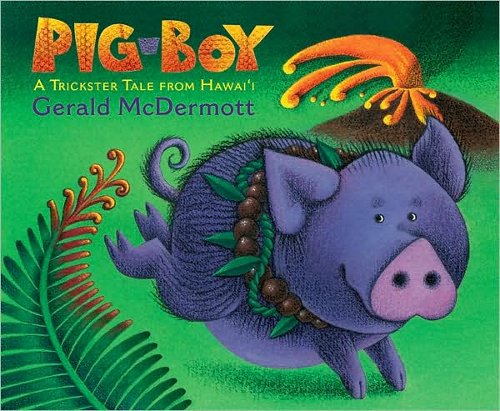
Pig-Boy: A Trickster Tale From Hawaii


McDermott, G. (2009). Pig-Boy: A trickster tale from Hawaii. New York: Harcourt Children's Books.

Genre: Myths
Format: Picture Book
Recommended Age: 3-9

Most people are undoubtedly unaware of anything to do with ancient Hawaiian mythology, which is why this story serves as a wonderful medium by which to communicate some of the unheard legends that have infiltrated Hawaiian culture for centuries. Pig-boy is a story based upon the god Kamapua'a, a trickster and a hero in Hawaiian mythology. This trickster often gets himself into precarious situations, yet as illustrated throughout the story, is able to slip away just in the nick of time by transforming into many different pig-like creatures that are seen throughout the Hawaiian islands, such as a hog, boar, and a pig-nosed fish called the humu-humu-nuku-nuku-apua'a. The brightly illustrated pictures will capture the attention of any young child, and those aged 3-9 will especially enjoy the opportunity the story brings to explore a faraway place from a faraway time. This book is a must for any school or library collection.

Scheps, S. Pig-Boy: A trickster tale from Hawaii [A review of the book Pig-Boy: A Trickster Tale From Hawaii]. Retrieved March 10, 2010 from http://www.amazon.com/Pig-Boy-Trickster-Hawaii-Gerald-McDermott/dp/0152165908.

Scheps gives this book a positive review, pointing out the many artistic expressions that she favors, such as the golds, oranges, and reds used to create human figures and the bright purple used for the pig-boy as he continually transforms throughout the book. Scheps also praises McDermott for leaving out a sexual element between Kamapua'a and the goddess Pele that is apparently a large part of the traditional tale, and points out that despite its absence the story is still as charming as ever. I agree with Scheps' review, and I too especially enjoyed the consistency of colors used for the characters withing the story, which can easily aid children in being able to differentiate between the characters. I found this story to be delightful, and am especially appreciative of the fact that I unintentionally received a history lesson while enjoying it.

The Neighborhood Mother Goose


Crews, N. (2004). The neighborhood Mother Goose. New York: Greenwillow Books.

Genre: Poetry
Format: Picture Book
Recommended Age: 3-5

This book is sure to give each reader a whole new experience of Mother Goose as contemporary photographs of inner city children at play jump off of each page to tell the story of each classic rhyme. At times, a single photograph encapsulates the entire rhyme, such as demonstrated in the rhyme "Georgie Porgie", where a little boy is seen chasing little girls around the playground. At other times, the author had her own fun by photoshopping several images together, making it appear as though a tabby cat is playing the fiddle, or as if thirteen shrunken children really could fit into a shoe. Whereas the content of nursery rhymes is typically intended for younger audiences, older children and even adults are sure to enjoy the visual elements of this book as well. Never have I seen a book capture the playfulness and free-spirit of children so beautifully.

Lempke, S.D. (2004). The neighborhood Mother Gosse [Review of the book The Neighborhood Mother Goose]. The Horn Book, 80(3), 339-40.

Lempke gives this book a raving review, as she proclaims Crews' photographs to be natural-looking and "brimming with infectious joy. " I couldn't agree with her more that the multiethnic children photographed throughout the story help "move the rhymes from their olde English roots into the present day." This is a book where the setting brought the story alive in a whole new way, and I would personally recommend it to those of all ages from all backgrounds.